Showing posts with label Neo-Nazism. Show all posts

Wednesday, 24 May 2017

Mark Taylor and the Nazis


Woden's Folk, the racist cult which reveres Hitler as a divine avatar, has a new logo. It claims that the logo was designed by someone called "Scyld".


Who is "Scyld"?


He is Mark Taylor, a man closely involved with the Steadfast Trust charity. He was, at one point, a trustee of the charity; when he was featured on ITV's Exposure, he was identified as being (alongside Tim Hawke) one of the people running the Steadfast Trust. I am unable to confirm whether or not he is presently involved with Steadfast following its deregistration by the charity commission.

The fact that Taylor is now designing logos for Nazis is still further evidence of just how racist the Steadfast Trust is.


Mark Taylor in the Exposure documentary on the Steadfast Trust.


Proof that "Scyld" is Mark Taylor

There is a member of the Anglo-Saxon Foundation forum called "Scyld Scefing". As you can see, he has repeatedly mentioned his involvement with the Steadfast Trust:


As a side note, he is also a blatant racist who supports the BNP:


More significantly, meanwhile, he gives his email address as wyrdart@butler-taylor.eclipse.co.uk:


How does this connect to Mark Taylor? Well, Taylor is a painter, and he runs a website about his work called Wyrdart:


And he also runs a recruitment consultancy called Butler-Taylor, as can be seen at his LinkedIn page here. The page will require a LinkedIn account to view, but you will be able to see his profile image by entering "Mark Taylor Butler Taylor" into Google Images:


Just to emphasise that the Mark Taylor of Butler-Taylor is the same as the Mark Taylor of the Steadfast Trust, look at this news report from the old Steadfast website:


So, "Scyld Scefing" is involved with the Steadfast Trust (like Mark Taylor) and his email address combines the names of a website run by Mark Taylor and a company run Mark Taylor. Who can be possibly be, other than Mark Taylor?

And there's more. Here's an individual on Facebook called Scyld Scefing. Note that his main image refers to Steadfast, while his photo album contains paintings from Mark Taylor's Wyrdart:


And to take everything full circle, just look at the stylistic similarities between these three images - the new Woden's Folk logo, the avatar of the ASF member Scyld Scefing, and an image uploaded by the Facebook member Scyld Scefing:


And, for even more evidence, here are additional threads from the ASF tying Scyld Scefing to Mark Taylor/Wyrdart:

Scold Scefing promise a new poster available at Wyrdart.

A discussion about Wyrdart, where Scyld Scefing mentions having updated the website.

"I hope Sclyd doesn't mind you doing one with his mail-dressed warrior, too. Perhaps work the word 'Wyrdart' in, to give him credit?"

Thursday, 10 November 2016

More on the neo-Nazi White Dragon Flag of England


The "white dragon flag of England" has been the dominant theme of this blog for a while now, and here I have another post shedding light on its origins as a neo-Nazi symbol.

In my first post on the subject, I pointed out a posting from the Anglo-Saxon Foundation where somebody states that the flag was created by Woden's Folk:


As I demonstrated here, Woden's Folk is a neo-Nazi cult that reveres Hitler as a messiah.

On 7 October Wulf Ingessunu, the mentally ill Nazi who founded Woden's Folk, made a blog post about the white dragon. He clearly did so after reading my post on the subject, as he used one of my images. Here is his account of the flag's origin:

The revival of the White Dragon Banner started back in the mid-1980's through the original White Dragon Kindred. Woden's Folk was formed on April 23rd 1998 and took up the revival of the White Dragon, which soon spread when it was made into a flag by the English Flag Society, who worked separately in reviving the symbolism, although the idea was put into the magazine of The English Companions (using the pseudonym 'Folk-Wolf') so we cannot tell whether it had been taken up from here or not. Whatever the case the White Dragon was revived and spread through Englisc Nationalism. 
The symbol spread very quickly, and at one time I did warn that we would be well not to totally discard the English Cross which began to be suggested. This was only because the White Dragon was, and still is, not well known amongst the English people at large, indeed when it is used many see it as a 'Welsh' flag. There have been arguments against its use because there is little historical evidence to show that the English used it as a symbol. This really does not matter at all since it is the symbolism that counts, and this symbolism is relevant to our struggle today.
So, in Ingessunu's version of events, the white dragon flag was invented not by Woden's Folk, but by a group called the White Dragon Kindred. He then goes on to analyse the symbol, which he associates with anti-Zionist conspiracy theories:
The White Dragon is the symbol of the struggle against the Red Dragon of Juda-Rome, the 'Great Red Serpent' mentioned in Revelation. The 'Red Serpent' or 'Red Dragon' is symbolic of 'Rome', the 'Treaty of Rome' (The EU), the USA (which sports the Roman Eagle as its symbol of imperialism) and the British State. It is also the Serpent Rouge of the Priory of Zion.
The post fails to provide any solid evidence of the white dragon being significant symbol to the pre-Norman English, and eventually descends into the kind of hocus-pocus gibberish that is typical of the clearly unhinged Ingessunu. At one point he brings up the Seven Swords of Wayland, which were created for the 1980s television series Robin of Sherwood:
In Wodenic Lore the Seven Swords of Wayland are symbolic of the Seven Tribes of Ingwe who have come together in these islands, and who make up the English Folk-Nation. These tribes have come from Northern Germany, Frisia, Sweden, Denmark, and Norway through the 'Anglo-Saxons' and the 'Vikings'. Northern Germany and Scandinavia were populated by the Ingwaeons ('Friends of Ingwe') who have thus united into one nation here in these islands. The Seven Swords of Wayland are a counterpart to the Seven Swords of the Seven Sons of Mimir. These swords are taken up just as Ragnarok approaches. These Germanic Tribes have united under the White Dragon Banner. 
The Seven Swords of Wayland are thus an important symbolism, even though they are found in a TV Series (remember that all this is archetypal); the Seventh Sword of Wayland is named 'Albion' and is wielded by The Hooded Man. Albion is an ancient name for England, and since Hengest is one of the Divine Twins, and thus Divine Ancestors of the English, he is the same archetype as Ingwe (and also The Hooded Man). In previous articles I have likened the Seventh Sword of Wayland to the Sword of the Wolsungas, i.e. the 'Broken Sword'. Albion = The White Island = The White Dragon.
So what, exactly, was the "White Dragon Kindred" that supposedly created the white dragon flag? I did a search on this group's name, and - with one possible exception - all of the sites that turned up were connected to Woden's Folk. The only person I could find who admitted being a member of White Dragon Kindred was Wotans Krieger - who also happens to be the most outspoken Nazi in Woden's Folk, and who appears to be using the names "Woden's Folk" and "White Dragon Kindred" more or less interchangeably:
Out of the blue approximately 9-10 years ago I received a mail shot from Woden's Folk and something resonated deep within me. I duly responded and joined that organisation as a Supporter, then quickly progressing on to an apprenticeship, becoming a Fellow of the White Dragon Kindred after my initiation and taking of the Oath of Profession.
Given that Ingessunu's group has operated under multiple names (including English Movement, Woden Brotherhood and Woden Folk-Community) I began to suspect that the White Dragon Kindred was simply an earlier name for Woden's Folk.

My suspicions were confirmed when, while working on this post, I found that Ingessunu had made another post on his blog about the white dragon in direct response to me:
'Radical Britain' ran a blog-post tracing the origins of the modern White Dragon Flag to Woden's Folk. Since WF was founded in 1998, and the symbol had been around and used over a decade before this, the statement is not strictly true. The first use of the symbol within the Heathen Movement was through the White Dragon Kindred which then operated as a separate group made up of activists within Odinism. I ran the White Dragon Kindred but this was well before WF was formed. [Emphasis mine]
There we have it: the neo-Nazi Ingessunu admits to being the man behind the White Dragon Kindred, the group which invented the white dragon flag.

Ingessunu then goes on to state that the flag contains a visual reference to the swastika:
The symbol we use is 'four-footed' which links it to the Fylfot-Swastika or 'Fol's Foot'/'Four Foot'. The fylfot is a spiral shown in a two-dimensional symbol. This also fits with the White Dragon being symbolic of our own Milky Way Galaxy, which is a spiral made up of 88 constellations.
After this, Ingessunu draws a parallel between the white dragon and the Nazi swastika:
The power of a particular symbol can be seen in the Swastika used by the National Socialists, a symbol of extreme power - an Aryan Symbol. True, this symbol had been used by many groups before, but the Swastika seemed to take upon itself a power of its own, a power that would unite a nation which was on the brink of collapse. 
[...]
The White Dragon Symbol seems to have taken upon itself a life and power of its own. It spread rapidly amongst the Englisc Nationalists until the movement splintered; but today the symbol has moved beyond the confines of Englisc Nationalism and is being used by various groups who oppose the New World Order. By instigating the collapse of Englisc Nationalism the powers-that-be seem to have inadvertently caused the symbol to spread even further afield, mainly amongst the stronger and more militant groups. It has even moved beyond the confines of the English.
Furthermore, Wulf states that the flag's colour scheme was baed around St. George's Cross: "We used the White Dragon on Red background from the start, as the colours of the English Cross Flag". So much for the nationalist belief that the white dragon flag predates George's Cross!


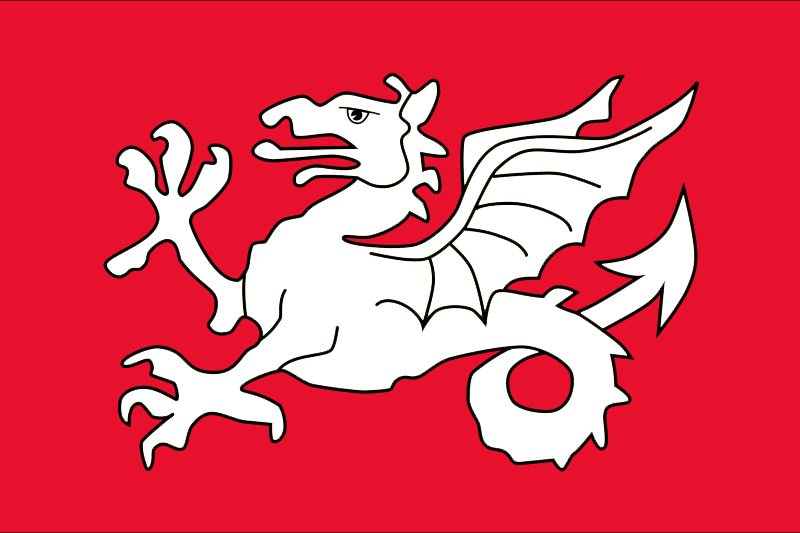
The "white dragon flag of England" is not an age-old Anglo-Saxon symbol, it is a neo-Nazi symbol. We now have direct confirmation of this from the man who first commissioned it. Any organisation that flies the white dragon should be treated as suspect.

Friday, 22 July 2016

Is the "white dragon flag of England" a neo-Nazi symbol?


"We wave the flag of old England on high; over past glorious battles the white dragon did fly"
— Martin Cross, neo-Nazi musician, in "Ballads of the White Dragon" (2000).

UPDATE: I have noticed that a large number of people are discovering my blog through this post. As the post in question is a little meandering, and does not include information that I found after I originally wrote it, I suggest that new readers instead read this post. There, I provide conclusive evidence that the white dragon flag was created by a neo-Nazi group in the 1980s. Then you can head back to this post for additional background detail.


Most of the "Englisc" nationalist organisations that I have written about on this blog share a symbol: a white dragon, usually in the form of a flag. Many Englisc nationalists think that this image should be adopted by England as its "true" flag, as opposed to the post-Norman flag bearing St. George's Cross. According to these groups, the white dragon was used by the Anglo-Saxons of pre-Norman England to represent their nation.

Here is what WhiteDragonFlag.co.uk, the official website of the English Flag Society, has to say:

Investigation by John Green, Secretary of The English Flag Society, of the Early English period between the third and eleventh centuries A.D disclosed many references not only to the White Dragon Emblem, but also others, such as the Boar, Raven, Wolf etc.Careful and scrupulous investigation, coupled with analysis of numerous references, showed clearly that the White Dragon, in terms of its representation of Englishness, was clearly the most popular.

The site fails to provide any evidence for these claims, of course. It goes on to state that “It is hoped that the White Dragon Flag will... replace the quasi religious Papal/Norman invention known as the St. Georges Cross”.

Given the lack of citations, and the obvious political agenda, I am rather suspicious about this account. So, I decided to do some research into the symbol's origins for myself...


Red and White Dragons


In using a dragon for its flag, the Englisc nationalist movement is obviously taking a leaf from the book of Wales, which has a red dragon as its flag. So, I will start by looking at the history of the Welsh dragon.

The usage of a red dragon as the national standard of the Welsh goes back at least as far as the reign of Henry VII, who carried such a symbol at Bosworth. The symbol was associated with the seventh-century Welsh king Cadwaladr, although - from what I understand - there is little or no historical evidence that Cadwaladr himself used the red dragon as his emblem.

Even more relevant is an earlier symbolic usage of the red dragon to represent, not the Welsh specifically, but the Britons in general.

The Historia Brittonum, a work widely (if controversially) attributed to the ninth-century Welsh monk Nennius, contains an account in which King Vortigern witnesses two fighting serpents, one red and one white; the white serpent initially appears to be winning, but it is ultimately driven out by the red. A boy, Ambrose, interprets the red and white serpents as representing the Britons and Saxons respectively:

The serpents began to struggle with each other; and the white one, raising himself up, threw down the other into the middle of the tent, and sometimes drove him to the edge of it; and this was repeated thrice. At length the red one, apparently the weaker of the two, recovering his strength, expelled the white one from the tent; and the latter being pursued through the pool by the red one, disappeared. Then the boy, asking the wise men what was signified by this wonderful omen, and they expressing their ignorance, he said to the king, "I will now unfold to you the meaning of this mystery. The pool is the emblem of this world, and the tent that of your kingdom: the two serpents are two dragons; the red serpent is your dragon, but the white serpent is the dragon of the people who occupy several provinces and districts of Britain, even almost from sea to sea...
The same story is used by Geoffrey of Monmouth in his History of the Kings of Britain, which conflates Ambrose with Merlin:
As Vortegirn, king of the Britons, was sitting upon the bank of the drained pond, the two dragons, one of which was white, the other red, came forth, and approaching one another, began a terrible fight, and cast forth fire with their breath. But the white dragon had the advantage, and made the other fly to the end of the lake. And he, for grief at his flight, renewed the assault upon his pursuer, and forced him to retire. After this battle of the dragons, the king commanded Ambrose Merlin to tell him what it portended. Upon which he, bursting into tears, delivered what his prophetical spirit suggested to him, as follows:- 
"Woe to the red dragon, for his banishment hasteneth on. His lurking holes shall be seized by the white dragon, which signifies the Saxons whom you invited over; but the red denotes the British nation, which shall be oppressed by the white..." 
The Welsh legend of Lludd and Llefelys also contains a fight between red and white dragons. The beasts in this story do not serve an obvious symbolic purpose, although it is interesting to note that the white dragon is identified as a foreign invader - hinting at a connection with the story of Ambrose/Merlin and Vortigern.


Did Saxons Use a White Dragon Emblem?

So, it is the legend recounted by Geoffrey of Monmouth and the author of the Historia Brittonum that contains the earliest known usage of the white dragon as a symbol of the Saxons. But how widespread was this symbol, and was it ever used by the English themselves to represent their nation?

Well, I have to say, my research has turned up little to substantiate the Englisc nationalists' claim that the Anglo-Saxons ever used the white dragon as a symbol of their country.

Certain sources indicate that a white dragon was used as the standard of Wessex; the seventeenth-century writer Winston Churchill (an ancestor of the twentieth-century Prime Minister) made this claim. However, other sources state that the Wessex standard was a gold dragon: Henry of Huntington writes of "Æthelhun, who led the West Saxons, bearing the royal standard, a golden dragon", and in present-day heraldry the symbol of the Wessex region remains a gold dragon.

The Bayeux Tapestry depicts Harold II alongside a pair of dragon banners - a red one in the air, a white or gold one on the ground:


The tapestry does depict a warrior with a white dragon on his shield... but his lack of facial hair indicates that he is a Norman, not an Englishman:


So, in summary, historical evidence for the Anglo-Saxons using a white dragon as a symbol rests on two facts:

1: A small body of legend, possibly of Welsh origin, uses a white dragon to symbolise the Anglo-Saxons;
2: The Anglo-Saxons sometimes used dragons as standards (as did other peoples) and some of those dragons may possibly have been white.

That's about it. Pretty thin rationale for redesigning England's flag, don't you think...?


The White Dragon in Modern Times

There's an English nationalist blog called Berrocscii's Banner that is unusually forthright about the white dragon flag's questionable vintage:

This flag, it has to be said, has its critics from within English nationalist circles. For the bigger picture I suggest you use Google, but to cut a long story short, there are questions over the flag's authenticity. Keen advocates claim it to be the prime Anglo-Saxon standard of pre-conquest England, but primary sources are few and arguably flakey. However, if Celtic identity can be reinvented and romanticised, then why not an English one? [...] The White Dragon, in it's present form, has been around since the 90s and it doesn't look like a flash in the pan. 

So, he openly admits that the flag was designed in the 1990s, and that its usage is an attempt to mimic the romanticised silliness of Celtic nationalism. But if the flag is a modern invention, then who invented it?

Well, when I was researching this subject, I found a revealing thread over at the Anglo-Saxon Foundation. One member, Valkyrie, asks about the origin of the white dragon flag used by the movement:


Paul Young, who posts at the forum as "Yngvi", comes out and admits that the white dragon flag is a modern invention:


Valkyrie asks who designed the flag; Paul states that he knows the answer, but declines to name the flag's creator:


Then another member, Ingelsman, claims that the flag was invented by Woden's Folk in the late nineties:


The thread lasts for twenty pages in all, but nobody disagrees with Ingelsman's claim - not even Paul Young, who is himself a member of Woden's Folk. From this, it seems safe to say that - yes - the "white dragon flag of England" is the creation of Woden's Folk.

Young stands by the flag despite its modern vintage, and apparently considers Valkyrie to be an "orcish fucking butt sucking shit cunt 3rd stage syphillis suffering bottom feeding rat shit smothering Anglophobic turd burgling wanker" for questioning its authenticity:


Valkyrie, meanwhile, seems suspicious of the group that created the flag


And she is right to feel this way. I have written about Woden's Folk multiple times before; founded by a mentally ill Nazi named Wulf Ingessunu, it is a white supremacist cult that believes Hitler to have been an avatar of Woden and that the 1980s ITV series Robin of Sherwood was a divinely inspired work of prophecy. These are not people who should be put in charge of designing England's new flag.


The Red Field

I have seen multiple variations of the white dragon flag used by nationalist groups. Here is the version used at the Anglo-Saxon Foundation; I believe it was designed by the forum's owner, Seaxan:


Here is the logo of the Steadfast Trust:


Here is a version on sale from WeAreTheEnglish, a site run by former Steadfast trustee Julien Crighton:


This appears to be the most common variation, incidentally - it was used by English Shieldwall, amongst other groups:


Here is a version uploaded to Wikipedia by the user Mafiga:


Here is a version designed by Dan Capp for the cover of Edmund Dee's book White Wyrm Rising:


Here is a version flown at a Woden's Folk event at Avebury:


Here's the version favoured by the nationalist blogger Berrocscii:


And an image search for "white dragon England" turns up even more variations:


Notice something that they all have in common? Each of these white dragons is against a red field. A few Englisc nationalists deviate from this model - the current Steadfast Trust website has a white dragon on gold, for example - but the overwhelming majority have a white dragon against a red field.

As we have seen, there is little hard evidence that the Anglo-Saxons used white dragon symbols at all. So, we can reasonably infer that the convention of a red field was introduced by Woden's Folk when they designed the white dragon flag of England.

Why a red background? Well, perhaps it is a holdover from the current flag of Wessex, which also has a red field. Perhaps it is a reference to the colour scheme of St. George's cross.

But that said, given the role of a neo-Nazi cult in the design of the flag, I have to wonder if the colour scheme was inspired by an altogether more infamous flag that also had a black and white design against a red field...


Here's a version of the white dragon image that makes the similarity even more explicit:


Is the white dragon flag of England a neo-Nazi symbol...?

Tuesday, 8 September 2015

Englisc Resistance


I decided to make a post about a racist Facebook page called Englisc Resistance, partly because I've seen a degree of misinformation about it being spread in antifascist circles. During the course of my research, however, the page closed down - although you can see an archive of it here. The Englisc nationalist movement can notch up yet another casualty...

As far as I can tell, the first significant mention of Englisc Resistance in an antifascist context is in this Vice article from September 12 2014, which briefly namechecks it as one of multiple "small but likeminded ethnic English groups".

Three days later Vice.com published an article by a different author, about a protest that was attended by members of far-right groups; "From the flags, it looked like it included the National Front (NF) and someone from the Englisc Resistance (that is the correct spelling)", states the article. This comment is illustrated with a photo showing the flags referred to:


This is where things have started to become distorted. The author appears to be working on the assumption that the symbol on the left-hand flag, showing a white dragon, a stylised swastika/fylfot and the slogan "Englisc - We Fear No Foe", is associated specifically with Englisc Resistance. This is presumably because both use the antiquated spelling "Englisc".

What the author seems unaware of is that Englisc Resistance is one part of a larger movement which also includes the Anglo-Saxon Foundation, the Steadfast Trust and other groups. Multiple people within this movement - which I have termed Englisc nationalism - have used the logo in question; for example, the Anglo-Saxon Foundation member Wodensson has it as his forum avatar:


I've also noticed a variation of the symbol, with St. George's Cross instead of a swastika, being used by some of the slightly less extreme nationalist groups:


A few months after the Vice.com articles went up, the Bristol Antifascists blog ran a list of various far-right groups. Influenced by Vice's work, this list includes Englisc Resistance in relation to the "Fear No Foe' swastika logo:


The description beneath the photo actually fits Englisc nationalism as a whole - the blog is confusing Englisc Resistance with the wider movement to which it belongs. The reference to burning crosses in forests is clearly derived from the first Vice article, which covers an unspecified nationalist group engaging in this activity but gives no indication that Englisc Resistance was responsible.

The following month, Brighton Antifascists published a list of far-right symbols which identifies the "Fear No Foe" swastika as the logo of Englisc Resistance:


I believe the man in this photograph to be Piers Mellor, who briefly appeared in the Exposure: Charities Behaving Badly talking about his involvement in the BNP, British Movement and National Front. Here is Mellor's response to the above snippet:


To give Mellor his due, I believe that he's entirely right in this tweet.

Having - hopefully - cleared up some misconceptions about Englisc Resistance, let's take a look at exactly what the people behind this now-defunct Facebook page stand for...
To start with, ER engaged in the tried-and-true Englisc nationalist practice of referring to non-white people as "orcs" and gloating over their deaths:


Despite being ostensibly focused on England r ather than the southern USA, the page showed a strange fascination with the Confederate flag. The first of these images is my favourite, making a nonsensical relation between the losing side of the American Civil War and the Anglo-Saxon festival of Eostre:


There are flags which Englisc Resistance was less keen on, however - such as the rainbow flag of gay rights:


In this post, Englisc Resistance republished an antisemitic cartoon from Der Sturmer:


In July the group posted a set of photos from a military exhibition; I did some digging and found that these images come from the War and Peace Revival in Kent. Predictably, English Resistance focused on the Nazi exhibits:


Englisc Resistance also appreciated this display of Ku Klux Klan memorabilia:


Who was behind Englisc Resistance? Well, the page was rather secretive on this front. Just look at the crudely scrawled-out faces in these photographs:


(Incidentally, the last of these images is from a Woden's Folk event at Avebury - more photos from the occasion can be seen in this video)

I couldn't help but notice that all three photos appear to show the same person. Each time the subject shares a similar build and, in two of them, even wears the same coat. So who is this mystery man?

Well, looking closely at the second image, I spotted something awfully familiar about that half-shaved haircut. He reminded me of Darren Clarke, one of the Steadfast Trust supporters seen in the Exposure: Charities Behaving Badly documentary. Here's a comparison:


I then compared the other two photos of the Englisc Resistance mystery man with one of Darren Clarke, taken at a March for England event:


Yup. I think we have our man.

Who is Darren Clarke? Well, when I first mentioned him on this blog, he was just another racist in the Englisc nationalist movement. He then went on to become the secretary of the Ipswich English Community Group. Not long afterwards he became an unlikely TV star when he turned up in the undercover footage seen in the Exposure documentary. I later demonstrated that Clarke was almost certainly the author of the book White Wyrm Rising: A Journey into Modern English Nationalism; in the same post, I provided strong evidence that Clarke is also the identity of the Stormfront member "Atrociter".

There is further evidence tying Clarke to Englisc Resistance. He was a regular poster in the page's comments section; here he is, showing his support for the Confederate flag:


Like many in the Englisc nationalist movement, Clarke likes to paint himself as an ordinary Englishman. But how many ordinary Englishmen feel such a passionate commitment to the cause of the Confederate States? How many would literally fly the flag for a neo-Nazi cult, as Clarke appears to be doing in the photo of the Woden's Folk gathering?

I will be keeping an eye out for Englisc Resistance in case it turns up again in a different form...